Saturday, March 21, 2009

Politics and equities

This is a response to this post

I am generally a person with left wing political views. I think it is much more likely for the government to cooperate with the OECD first to crackdown on tax evaders who have money offshore.

Despite my political views, I do not have much optimism in Obama I do expect the markets to go down further and the Bernanke/Obama "reflation" agenda to "fail" (as in not spark new consumer lending or cause stagflation.) I still believe in deflation though, and as the discount rate for long term illiquid assets (stocks are relatively illiquid) rises resulting in investors asking for an increased risk premium for holding onto equities and not pricing in economic growth which would drive down the price of equities, people will liquidate and switch to more liquid assets. They will give up on trying timing the market and profit on a recovery (it probably would not happen anyway) because their discount rates have gone up so they want to protect themselves from nominal short-term losses in assets such as equities. The result is that most people who do not have a long time horizon would not hold on to equities.

So what does this mean? Generally people who hold stocks have more conservative political views and tend to vote Republican. If one lets the process go on untouched, it would result in a shift in a preference for more left-wing policies and a preference for labor over capital since less voting people own stock. But if the government tries to intervene in this natural process (a referrence to the proposal of confiscating IRAs and 401(k)s), they would lose some potential supporters as these people would feel that the government harmed them by confiscating their assets. Thus, it is simply better for the government (if it seeks to generate people with more left-wing views) to let the Darwinian flush in the equity markets to go on unabated and let them relinquish their equities naturally although that would be a painful process for many.

Most people are incompetent at managing their own money and they do realize that now. This incompetence can be explained by the information asymmetries that professional traders have over retail investors, and as explained above, they have higher discount rates during times of crisis which leads them to make bad long-term decisions. I think there will be little resistance to more government involvement in a democratic population now. The people voted for Bush in the last election because the asset bubble in housing and stocks made plenty of people happy despite the economic fundamentals which also explain the tolerance for policies that favor capital over labor.

Thursday, March 19, 2009

Thoughts on the dollar, treasuries, and inflation

Although unusual from my recent ramblings... this post will be more coherent since I wrote it in response to a blog entry from Stefan Karlsson. I saved it because there is a chance that he might delete it.

I thought long-dated bond yields would go up despite a deflationary environment. My reasoning is based on the fact that in a deflationary environment, people generally would move towards liquid assets and relatively shun "duration" exposure so the yield curve would steepen unless the front-end interest rate was high (which is usually the case before a recession). Also, Brad Setser reported increased demand for treasuries by private investors in the 3rd and 4th quarter of 2008. (Setser, to the best of my knowledge did not say anything about the duration preferences of these investors.) I think that this was a one-time maneuver by many investors shifting a large portion of their portfolio into bonds (bond demand would not be financed by a stream of income by private investors) so a large portion of their capital is already exposed to treasury bonds. In addition, foreign demand for long-term treasuries I expected to decrease as government's acknowledge the risk of the "risk-free" long-dated asset (Sester did acknowledge this) and lower trade surpluses in many of the US' trading partners. Lastly, even though private saving would go up, I suppose it would not finance the large deficit as the private sector attempts to deleverages themselves and prefer more liquid shorter-duration exposure. In addition, earning power would decrease so less money would be available for saving which is different from the Japanese scenario. It would seem that the increase in supply for treasuries (especially long-dated) would outstrip an increase in demand if we excluded the printing-press and people suddenly buying bonds after they heard of Bernanke's QE policy (even if there was not sell-off caused by a bursting of the "bond bubble"). I thought Bernanke would result to using QE eventually, but I actually expected yields to go up during the bear market rally.

I did expect the dollar to rise against the euro because it is the world's reserve currency and the world is highly levered in the world's reserve currency so this would increase the demand for dollars during deleveraging. But once the deleveraging was over, the dollar would resume its fall. In addition, the eastern european exposure to the euro would cause significant stress to the currency regime and maybe lower euro interest rates in an attempt to "stimulate" the economy. Also, I erroneously thought that the US trade deficit would narrow (it did), but the latest trade data showed that exports declined more relative to the decline in non-petroleum imports.

Of course, in the future, there is a non-trivial chance that the velocity of money would dramatically accelerate. This would cause inflation or hyperinflation (as defined by an increase in prices), not simply increases in the money supply although that might be the catalyst to trigger such an increase. Of course, inflation and hyperinflation do have a reflexive component to it, and since people believe that the Fed will cause inflation, as it did by increasing the money supply, it drives gold prices up as people seek "real" exposure, not "nominal" exposure. Gold prices do not measure directly inflation as there was positive inflation in the 90's yet lower gold prices as people wanted exposure to assets (or "delusion" in the case of most dot-coms). It measures some derivative of the demand for "real" exposure relative to "nominal" exposure which would increase during times of both deflation and in some inflationary environments. In a deflationary environment, "nominal" low-duration exposure might not offer significant interest, so the opportunity cost for holding gold would be lower. This is one reason why gold could rise in a deflationary environment.

I do not think "reflation" will "work" (which I'll define as producing "desired results" not merely producing inflation.) Even if banks become well-capitalized when the government monetizes their assets, it would not spur "enough" lending because the demand for lending would decrease. While Bernanke can lower the interest on interest-bearing assets by intervening in the bond market by buying agencies and government debt, it would not necessarily lower the "spread" or risk premium for those type of debts and consumer loans. The spread, of course, needs to compensate for the risk in the loans the banks make. I expect a situation similar to that of Japanese banks if the banks are to become well-capitalized. It seems that Bernanke's goals for QE is to lower the interest rates for consumers to get loans rather than recapitalization of banks although the latter is means for the former. I do not think QE will achieve this end. QE might not necessarily cause inflation in a given nation if it is not invested in a the country (in Japan, it might be used for "carry trades" in other currencies) or if the excess money was withdrawn from the money supply after it recapitalized the banks (which happened in Japan according to the figure here).

I still like the deflationist thesis and "Mish" (and not Peter Schiff) made me consider the merits of Austrian empirical economics, although I do not like some Austrian normative economics. Regardless of "deflation" and "inflation," this is an environment characterized by hoarding not entrepreneurialship... who knows whether it will be cash when the velocity of money is low, or real assets.

Wednesday, March 18, 2009

EVERYTHING just went to hell

I do not like USD/EUR since it past resistance and trade data doesn't seem to be helping it.

I like

SEK/EUR (25%)
SEK/JPY (30%)
SEK/ USD (15%)
CAD/EUR (20%)
AUD/EUR (15%)


Close short USD 10 year bond position at a large loss (a 47 bp move against position today)... I knew of the risks of betting against a bond market with government as a buyer (I didn't target 30 year because it has possible to have yield curve flattening and the duration risk of that position). Whatever.... I knew yields would rise without QE.

Like long GLD now... this event seems to be the catalyst to encourage more gold "investment" buying.

Tuesday, March 17, 2009

Exit strategies

I do not like USD/GBP anymore... bearish sentiment is already priced in at $1.40 so it does not seem the risk/reward is yet compelling. Most traders now know of the BoE policy of quantitative easing. If it rally which could happen during the global bear market rally, then I'll reconsider a short position.

EUR/USD approached 1.30... I think this is resistance, but we might see a breakout due to the current global "bear market rally." I do not think we are at the bottom yet. This bear market rally would become something shortable (perhaps in equities and commodities) in about a month or so.

I think the yen will get weaker relative to the dollar in this bear market rally... plan to close short yen/long dollar at 104-108 yen per dollar.

I'll close the short treasury trade at around 3.10-3.20% (I do not think yields will rise further in a deflationary environment) and they can fall that much during a deflationary bear market rally.

Thinking about the timing for a short copper/oil play... I am also bearish on gold too although people such as John Paulson seem to be betting on inflation (or numerous fiat currency collapses).

I am still a deflationist... I will not switch to the hyperinflationist or inflationist paradigm unless I see nominial wage increases or if the price of consumer goods such as clothes or cars go up. It is actually funny... many people are afraid of inflation because they experienced rising food and energy prices. I like the Austrian economics definition of deflation: the net expansion of money and credit, not the PPI, CPI, etc. I do not like the normative views of most Austrian economists, but those guided by an Austrian view who forecasted deflation [and that doesn't include Peter Schiff] got it right on the money. According to this view, one could have rising prices during a deflation in food, energy, or in imports (if a currency collapsed) as these prices would be affected by other things not directly related to credit and money supply such as scarcity (can happen during a deflation due to the lack of investment in farms, oil exploration, etc.) and demand in other countries. But again, what is funny about this deflationary bust and inflation... most people still fear inflation because they experienced the dark side of inflation (it can be caused by the symptoms of inflation, but it is not necessarily inflationary) in the form of rising food prices and energy prices (of course in the long run these are legitimate fears), but they do not appreciate one of the ostensibly "good" effects of inflation: nominal wage increases because that has been driven down by globalization.

Again, I do not care what the CPI or PPI (rising numbers do not falsify the Austrian deflation definition) says: we are still in deflation where people will become more thifty so the velocity of money will slow down and people will be relunctant to take on debt. The deflationary bust will last longer than people think and we will soon appreciate its negative effects.

Saturday, March 14, 2009

I would add to the SEK position now.

Thursday, March 12, 2009

Bear market rally?

I most definitely do not think we are close to THE final bottom, but I would remove the Russell 2000 index hedges now although it was after the recent rally, so it wasn't perfectly timed.


18% exposure in long equity is not much although I think the equity picks would underperform the indices (if I would be evaluated on a relative basis) as bank stocks might lead the rally. The risk/reward is not compelling though as I could imagine a few scenarios that could bring the equities markets lower, but I do not think we will have a retest of the new lows for awhile. SPY would probably test the 800 level in a month. I really hate establishing positions after inflection points... but I think we are about to enter a bear market rally. I do not know if we are going to best the 900 level on the S&P, but 840 seems likely.


Still bearish on the entire US bond market. Short trade does have a negative carry of about 2.90%... let's say that 2.90% is when I got bearish on 10 year treasuries. So I need about 3.20% yields to break even. I think it is just a matter of time for yields to go up as I think the money to buy these the bonds would eventually dry up. There, of course, is a risk of quantitative easing by the Fed though.


Still bearish on CHF/EUR/JPY/GBP


The CHF position did well today with a fall of 3%.


PMI ---> PM.. people will still smoke...

Tuesday, March 10, 2009

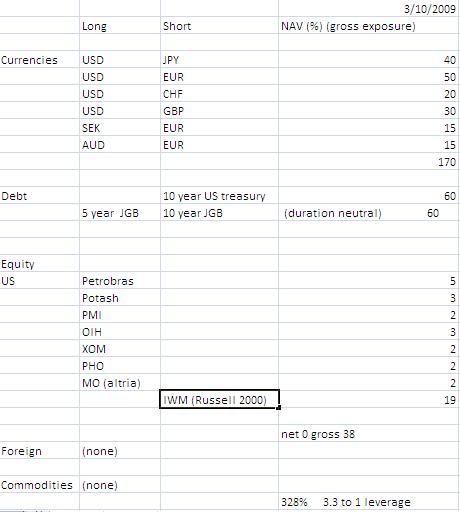
positions


I don't feel that deflation (defined as falling prices) is very likely in the Eurozone given that their economy has more wage/price rigidities.