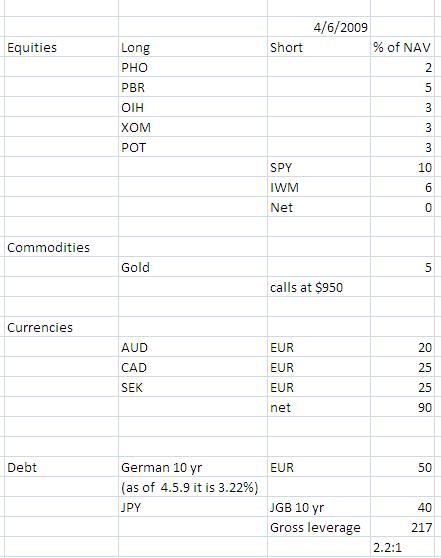
Showing posts with label real-time experiment. Show all posts

Friday, May 1, 2009

5/1/09

I have three trades that I have a strong conviction on...

Short SPY (and possibly IWM later), long US 10 year bonds (didn't put this on yet), and long German 10 year bonds. These trades require one to have a long time horizon and I am nervous about the timing of the former trade. Even people who are agreeing with me that this is a bear rally scares me. I know I am right about the future direction of the equity markets, but one does not outperform when others agree with you.

So on Monday, I expect the market to open lower and that would be a good time to by 10 of NAV of XLP and 5% XLY. These are short-term hedges to the SPY short (i.e. SPY short should not be considered a hedge to the SLP and XLY longs) and I believe XLP would decline less during a dramatic sell-off when compared to SPY. I also expect most short term traders would buy on Monday to give the bear market rally more steam. These are regretably, trades, as I plan to dump them as SPY hits new local highs by the end of the week. The timing is done to reduce risk that the longs would offset the gains in the SPY short. The trade is risky because I love the SPY short, and those long positions would not allow one to realize the gains in the SPY short because one is using a "market-neutral" strategy.

I would not add to my short position yet. I'll let the market move against me initially.


Edit: copper will rise today, but it will sell-off on monday.

Edit2:
Go long on XLP (10%) and XLY (5%) today. I think market will open higher on Monday. Copper will probably rise on Monday. Gee... this diary is forcing me to criticize myself and vacillate.

The copper positions have to be closed. Take the damn loss at $2.12 (3.5%) because I could imagine a scenario where it could go higher. You're wrong, and just admit it. (I am talking to myself). It could go higher than its recent high of $2.20. Sterling will be closed at loss on Monday. Short copper might be attractive position if the futures curve is in contango as it was backwardated recently. Short oil seems to be good too. I'll keep silver long though.

I expect the bullishness to continue. I am a short term bull now, but this market is stressing me out. It is forcing me to think like a trader and contradict myself.

I'll use bond and commodity market indicators as proxies for bullish sentiment in addition to equity technical indicators. It is much like organic chemistry: how do you interpret these peaks? (a reference to IR and NMR spectroscopy) What does the market tell us and what is priced in? I should look at the futures curve in base metals and see if it is in contango. Contango can be interpreted as inflationary expections/and or a sign of economic recovery. I like the 5 year bond yield as another indicator since it reflects investors' estimates of their return on investment for that period of time. It is currently at 204 basis points. It should at least break the Feburary 26 highs of 207 basis points, although 220 basis points would make a short position in SPY more attractive. Also, the spread between TIPS and the bond of the same maturity can be used as a nice inflation expectations indicator. (The 10-30 year bonds might have a catastrophe premium to it such as pricing in hyperinflation or a debt default which could explain the extreme steepness of the yield curve.) However, TIPS have a liquidity premium attached to it as the market is less liquid, but I expect liquidity would increase in this market (at least for the short term.)


The commodity market at least has some hedgers in it so it conveys some useful information. The bond market, unlike the equity market, has a higher barrier for entry. Bond traders have longer time horizons, and the market is not dominated by trend following traders. There is also less upside in the bond market, so they are not motivated by status concerns such as wanting to brag about a position that went up 100% at a cocktail party.

Thursday, April 30, 2009

Add to short positions today

Add to 5% of NAV to SPY short positions at SPY $89.00 . This would increase the net short positions to 20% of NAV.

Edit: it did test the $89.00 level (and failed), but I'll add at $88.90 . (it did not retest). On Friday add 5% of NAV to SPY shorts if the index rises on the first hour

Edit2: it did go to $89.00 on the yahoo finance chart, but not on google finance. It only happened for about a minute. If I was pretending of running a hedge fund, it would not be possible to build large short position in that time frame.


I also regret putting on the sterling and possibly the copper shorts. (because I was too late) I do love silver though. In short, I think the preference for gold instead of silver as a store of value is irrational. Gold looks pretty, but the ~ 70:1 ratio of gold prices to silver prices is a very high premium for gold. Besides, there are too many gold bugs on seeking alpha and longing it seems to be more of an expression of libertarian political views than a smart investment decision. But I do think gold and silver will do relatively well. I could imagine scenarios for gold to fall though, and I will consider entering short positions in gold if it rises.


Let's say I shorted copper (let's say the contract matures in fall) at $2.05 per pound and that reverted to that today. Also, I screwed up on the timing on the sterling short. Let's say that I shorted it at $1.45 on 4/20 . I only regret the timing of the sterling short, but I think it would fall.


I am also bullish on Treasuries now (which are probably the most reviled financial instrument in Seeking Alpha), but I would not declare a position yet and will add to the German government bond long position if yields rise. I also will consider shorting oil at $58. I rather short USO instead of the actual futures... I love betting against retail investors and the contango of the oil futures stymie USO.

Edit3:

I've switched my view on shorting SPY... I thought it was near a sell-off and was currently supported by inexperienced short-term traders. Yes, that might be correct now, but it is likely this bear market rally would last a little longer. Now I expect good economic news (which will fuel the short-term traders too) and entice bigger money into this market. This would increase liquidity and make it seem to be more safe to be in equities. My long term position is based on discounting and general deflation: there is so much overcapacity (except in medicine and energy [in the long run]) which would lead to competition. The overcapacity and competition (globally) would lead to low returns on equity for many firms. It doesn't matter if consumer confidence is up on a given month, and I do expect those numbers to increase in the short-term. Other people will say that it is all clear and the institutions would start buying. My hypothesis of the short-term "traders" bailing causing a sell-off doesn't seem to be correct now. But, I do love the short position as I speculate those short-term "traders" have net long positions and I am taking the other side of those long positions. Those "traders" as an aggregate have to lose and they will give up when they realize that trading is zero-sum even though they correctly know what buy and hold doesn't work. (I have an elaborate model to explain that, and I might post this later if I have time to write that.) I do not have to bet against a single trade they make, but betting against the aggregate's net long positions seems to be a one-way bet; the difficulty is optimising the timing. In my previous blogs, I noted my motivation for going short was actually fear because the one-way trade seems irresistable and being late means missing it.

Also my discounting model is another fundamental reason for going short. Corporate debt, of course, should increase the discounting rate in equity valuation though because of the possibility of liquidation. Even if a company doesn't have any debt, the equity should be subject to a higher discounting rate because it is equity: unlike debt where one knows the duration and amount of payments as debt is often referred to "fixed-income" while earnings is more turbid. With higher discount rates increasing the equity risk premium and lower earnings due to competition and overcapacity, it seems that equities are still overvalued. I do have a thesis for when it isn't overvalued, and that is when the paradigm shift will change the perception of equities. Equities will be seen as yield instruments, not as growth instruments.

I do plan on adding to the short positions in a slower fashion, because shorting the broad equity market seems to have a good risk/reward. I might have added early, but I will add on Friday. This seems to be one of those trades (and it is so simple to say that broad equities will fall eventually) where one simply has to be pig. I still have my convictions though as the position is a long term one.

I might consider longing the SPDRs of consumer discretionary and consumer staples for a trade. I expect those to rally during the course of the bear market rally, while the "junk" financials (such as Citigroup) will sell-off again. I consider these "trades" as they are not congruent with my macro perspective. Maybe long XLY or XLP (discretionary/staples respectively)/short XLF would be a nice way to institute that view. Or I might go long XLY or XLP to hedge the short SPY trade. Big money is likely to long consumer staples in this environment.

Wednesday, April 29, 2009

Expecting a rally today...

I am expecting a rally today, and it might extend until Friday. Financial news services explained that the market was slightly down this week because of the "Swine Flu Scare." Of course, that is somewhat true, and of course, I do not, and one should not base their valuation of securities only the immediate news. It might rally because they are not focused on that now.

Of course, I do not have enough conviction to declare a position (for this short term view), and I do not like very short-term trading.

The market is receiving its epiphany that the rally is an illusion. (In fact, it already has.) The market will dramatically plunge when market participants realize that they cannot profit from the rally. It seems that, paradoxically, low volatility might actually set off a downward plunge. It seems that the market doesn't have enough steam for it to even hit $89.50 SPY.

I am thinking about finally declaring a large directional short position on S&P 500 and the Russell 2000 on Friday. The motivation for this is personal fear, as I fear I might be too late in going short before the sell-offs begin. Again, I do not think it would hit $89.50 now, and when I wrote about that price for declaring a short position, I was feeling more bullish in the short term (1-2 weeks.) Instead of $89.50, it would be $87.00-$88.00 as the entry point as that seems to be resistance. Even if I am wrong, and it does break out to $91.00-$92.00, I still think it has a nice risk/reward profile at that level. In fact, those losses would probably make me even more bearish and actually make the position more irresistable since the losses do not falsify my discount rate views.

I am starting to have strong convictions about when this rally would end and at what price, I would not be conservative and use hedges. My declared positions were largely market neutral during the bear market rally although on March 12, I declared it was a bear market rally and decided to remove hedges. This rally happened too quickly, but it was forecastable in hindsight. When I started the real-time experiment, I was bearish (on the really long term on global equity markets (especially the US, and probably Europe)), but it was obvious to me that entering the short positions then (when the market was already beaten down and when everyone was already pessimistic) didn't have a good risk/reward. Declaring a short position now has a nice risk/reward if we compare it to the risk/reward of going short at the beginning of March because everyone is not bearish as some expect the rally to continue, and that there is some disagreement.

I decided to become market neutral, and the rally happened too quickly. (to reiterate.) On March 9, 2009, I think the S&P 500 rallied about 6%. It was too late for me to call the start of the bear market rally. I thought it might be possible for the market to continue to fall at that point, and resume the downward slide. It was only possible to know that it was a bear market rally in hindsight and it took me March 12 to do it.

Again the market has a zero-sum character. For example, the S&P 500 has rallied about 25% from its recent high on April 17 when compared to the March 09 low. Could one make a 25% profit from longing equity futures by holding them? (One could make more if one knows how to trade the volatility.) Yes, if you did so on Friday March 6? But most people who did expect a bear market rally either bought too early or too late so they would make less than the 25%. If they all bought at the same time, they would bid up the price so they people who bought later would have less upside since the price was already bid up. (This market of course is weird as it seems that people are worried about price instead of value, but in a bear market context, the bull market scenario is best represented in the dot-com bubble.) Again, the aphorism buy low sell high works and it can make some people rich, but it cannot make EVERYONE rich.

But, we are still in a positive sum game right since if one bought equity futures, one would still have a gain even if it would be less than 25%. So where are the losses in this zero-sum game? I would say that people who sold their stocks (or short sold stocks) when everyone was already pessimistic and fearful (and afraid of loss and wanted to protect themselves.) They forfeited upside volatility to eschew downside volatility. Also, they people who expect the bear market rally to continue or people who think the market would recover soon would also lose. Of course, the latter group is practically non-existent now, and it would seem that some short term traders who think the bear market rally would continue would loss to those who would sell because they switched their focus to the long term.

Sunday, April 26, 2009

Short interest

I am going to post a few links about shorts:

http://www.fool.com/investing/general/2009/04/14/pity-the-short-seller-in-a-market-like-this.aspx (Pity the Short Seller)

http://greenlightadvisor.com/glablog/2009/04/18/stock-performance-based-on-short-interest/ (Stock Performance by Short Interest)

http://online.wsj.com/article/SB124060826688554161.html (Short selling falls)

http://online.wsj.com/article/SB123915041409099017.html (More investors say bye-bye to buy and hold)

http://online.wsj.com/article/SB123981155929121475.html (Great investors who survived the great depression)

http://macro-man.blogspot.com/2008/11/few-thoughts-on-banks.html (thoughts on banks: see charts)

In the exchanges' latest twice-a-month statistics, the number of short-selling positions at the NYSE not yet closed out, known as short interest, fell 2.9% in the period ended April 15. The positions stood at 15,703,379,301 shares from a revised 16,173,689,617 shares in the period ended March 31.

On Nasdaq, short interest fell 4.8% to 6,708,317,025 shares from 7,048,839,387 shares, over the same period.

Investors who short shares borrow and sell them, betting that share prices will fall and that they can buy them back at a lower price for return to the lender. Stocks also can be shorted for reasons other than bearish bets, including hedging strategies.

Marketwide, the short ratio, or the number of days' average volume represented by outstanding short positions, rose to 3.2 days from 3.1 days at the Nasdaq in late March.

The short ratio on the NYSE rose to 2.5 days from a revised 2.3 days during the same period. The Wall Street Journal uses average daily composite volume to calculate the short ratio.


And that graph...


I suppose a nice price to short SPY is at ~ 89.50. Reasoning??

Most people do agree with is a bear market rally, and of course, they are indeed correct. I think a majority of these people think the market has the potential to go up to SPY 95.00 or maybe 100.00. However, with game theory considerations, I would not think it would reach that price if it hits ~90.00 .

First, we should consider the players in the market, and that the market has a zero-sum character to it. (No, I am not interested in academic discussions that the market helps firms raise capital by issuing equity stakes, or futures markets allow producers to hedge...). In other words, one gains the market comes at another person's financial loss, or by others paying an opportunity cost. For example, a producer who wishes to hedges in a futures exchanges pays the opportunity cost of forfeiting the upside of higher prices for the commodity he/she sells. The hedger does not loss any money because he could actually deliver the commodity and cover the liability even if the short position increases in monetary value. If it is speculator vs. speculator, the speculator selling short losses to the speculator who took the long position if the commodity rises when he buys back the position at the maturity of the contract. In the stock market, one who sells a share of GOOG forfeits potential capital gains (it doesn't pay a dividend) if the price of Google stock rises. The person selling the stock does not lose any money if Google rises as he doesn't have to take on a liability by shorting Google to sell it, but he does pay an opportunity cost if he sells the shares and receives the market price for it.

Now, who are the major players in the market?

Short-term traders (let's assume the WSJ characterizes them in the aforementioned link/ they are novice and should not be confused with speculators who do have information edges, have control of their emotions, and experience.)
Quants
Long-term institutions (hedge funds, wealthy people)
Unsophisticated long-term investors (e.g. people with pension funds, and who watch CNBC)

Let's assume that the prognosticators are correct and that SPY is going to rally to $95.00. The assumption is fairly reasonably, as $95.00 is approximately the 200 day exponential moving average of SPY. If it does hit $89.50, and goes to $95.00, one would have a six percent gain.

I choose $89.50 instead of $90.00 because there is a chance that it would sell-off at $90.00 or when it approaches that number. I would add to the short if it goes to $92.00-93.00.

Quants typically do not go into a large net-long position as they often hedge their positions, and they might turn down their trading volume, which would lower liquidity in this market. Also, since quants are large, they do not have an incentive to go for a potential 6% gain by increasing their net-long position.

Long-term institutions would not be tempted by a 6% gain by being long the stock market. They might try to hedge and outperform by correctly picking stocks since they have superior informed to short-term traders and long term investors. Also, since they have enough capital to hold large positions, holding large positions based on short-term forecasts is not a good idea in a relatively illiquid market. The dividend yield (currently 3.27%) does not compensate for the potential downward volatility.

Regarding the latter, they are too afraid to put their money in the market and a potential 6% gain would not offer a nice risk-reward in the short-term. Furthermore, trading should be difficult by definition, not everyone can could get wealthy in the stock market. Not everyone can follow a forecast that says the bear market could end at SPY 95.00 and sell (or short sell) then because of the zero-sum nature of the market. Whose going to be the idiot that buys when SPY is at $95.00? Essentially, they are receiving the dividend yield of SPY (there could be dividend cuts) and they would be assuming the risk of price change in S&P. Of course, most individuals do not purchase indices, but it is a nice approximation of the net actions of market participants. Again, someone has to loose.

Regarding short-term traders, they do not have an information edge for holding stocks in the long run. They have high discount rates and if there isn't enough momentum (i.e. an influx of cash in stocks), they would liquidate their positions as their positions as they are risky-short term trades. By definition, they do not hold positions for the long run, and a 3% dividend wouldn't be attractive. These short term trades are much like ponzi-schemes; for example, they usually do not buy Citigroup shares because they think companies' equity has any intrinsic value, but because they could sell those shares at a higher prices. Those trades might be vindicated in the long run, but again, they do not have the capability to analyze securities in that fashion. If they are not compensated by high short-term returns, they would just liquidate long positions, and stop-loss orders on positions would lead to a contraction of liquidity and lower prices in a positive feedback fashion. Of course, it is possible that some short-term traders would put in money in the stock market because they are not primarily motivated by financial gain, and trade for other reasons. In other words, they would have an above average risk tolerance, and accept a negative expected value. However, there must be enough of these type of traders to bid it up.

Assuming no other players in the equity market, such as institutions and long term investors, the trading activity of quants and short-term traders is zero-sum. It is a reasonable assumption to presume Ph.Ds who understand partial derivatives and linear algebra would formulate models to defeat the short-term traders (and generate "alpha"), but ironically, they were defeated by the short-term speculators who longed financials and consumer discretionary when the bear market rally became an established trend, and had to cover their corresponding shorts. Of course, most short-term traders are unsophisticated and cannot short. See this entry from Zero Hedge about the failure (for now) of the quants.

Since short-interest is down, it seems that this would not be fuel for a rally. And besides, if going long doesn't have a good risk/reward profile because if it goes to $95.00, you only make 6% if you buy at $89.50, and you have to deal with the potential for loss such as a retest of the March lows. Conversely, a short position is the enantiomer (a chemistry term, if you do not get it, just replace that with "mirror image") of a long position: if one is short, one risks a 6% loss, but one might be rewarded with a retest of the March lows. Perhaps, the $95.00 for SPY in a bear market rally would be a self-fulfilling view, but game theory considerations argue against it.

My short-term considerations show that short SPY $89.50 has a nice risk-reward. Longer term makes it even better. For example, I'll quote from this Wall Street Journal article:

All it took was the 100 shares in American Telephone & Telegraph that his grandmother owned to improve his family's experience of the 1930s. Schloss's parents, brother, sister and grandmother all shared a three-bedroom apartment on the Upper West Side of Manhattan, where horse-drawn wagons still delivered milk and the ice truck came by weekly. AT&T's annual dividend of $9 a share went a long way at a time when median rents in that neighborhood were $32 a month. Back then, Schloss says, a dividend was the primary reason "regular" folks invested in the stock market.

In other words, stock were not trading vehicles nor did people expect to profit from capital gains. I expect this would repeat.


In other blog entries, I argued that I expect the market to further fall because of high discount rates by market participants in financial markets. These high discount rates are caused by ignorance and incompetence (i.e. an inability to analyze securities to understand their technicals, and their "intrinic value" and cash flows), the empirical falsification that equities do well in the "long run" (let's use ten years), and the inability to take short-term losses (even ignoring my first point about ignorance and incompetence ) due to lack of financial capability (i.e. people afraid of losing their jobs because they would be deprived of cash flow, and they do not have savings or inflated assets to support them). High discount rates should be reflected in lower P/Es and higher dividend yields. Also, a high dividend would protect one from increased downward volatility and decreased liquidity. In addition, one would also receive substantial capital gains when discount rates falls, which is similar to being long duration in bonds when interest rates fall.

Of course, if the position moves against you, the risk/reward profile would look even better, and it would be tempting to add instead of cover. It seems that this rally is about to end, but it would be more disappointing if it ending before it hit $89.50, than if you incur a short term loss if the position rises against you.

Wednesday, April 22, 2009

I would close the CAD and AUD positions or reduce them to about 5% of NAV each.

Monday, April 20, 2009

New trades

Deflation theme:

add:


20% NAV short copper
20% nav long silver

50% NAV short GBP/USD

I knew 870 on SPY was overbought, but I didn't say anything about it. Since trading is zero-sum I didn't declare any positions, although I knew there would probably (like an 80% chance of a sell-off on Monday), I didn't expect it to be this large. I do not know if this is the resumption of the bear market or whether the rally would continue. It seems to me that the gap from the high 200 day EMA and the value of the SPY would mean the rally has some more steam.

One has to trade as little as possible since trading is zero-sum. Of course, from an SPY of 870, I knew it had to fall. One was waiting for it to go even higher before declaring a short position. I thought 890 would be a good time, since a sell-off might happen before it reached 900.

Edit: 4/26/09

I meant to say overbought on a long-term and very short-term time frames. On a medium term, 870 S&P 500 it seems that the rall would continue.

Again, I do not like trading. Trade minimally... A speculator (unless you are a quant) should engage in a minimum amount of trading. That doesn't mean buy and just forget about it.

Thursday, April 9, 2009

I'll close out all the equity positions... except for petrobras and a corresponding s&p hedge

Actually, equity gains were matched by the losses in the short hedges. If it weren't for the large petrobras position and its gains . IWM short was absolutely horrible.

Monday, April 6, 2009

4/06/09
reducing the SEK/JPY to 12% NAV

Edit:
SEk opened up higher this morning, like one percent against both the dollar and yen, but it went down. I thought it was a good time to close yen positions, now I did that.


Thursday, March 26, 2009

The disaster of "consensus investing"

Early March Saw Largest Increase In Short Interest In 9 Months

I didn't perfectly time the "bear market rally," but I was bearish before I started the "real-time experiment" (basically what George Soros did in the Alchemy of Finance without any money)... but Zero Hedge points out that there was a large increase in short positions between 3/2/09 and 3/13/09. Remember, it is a bad time to short when most people are doing it and when everyone is already bearish. I suppose metagame and game theory considerations are important when investing/trading/speculating. I did not want to be net-short during early March because it seems a rally would be a realistic possibility.

Right now, I suppose there is enough bullish sentiment and enough people disagreeing with my views to allow me to be net-short in the US equity markets with a moderate risk/reward profile.

Remember, you always have to question yourself and attempt to falsify your own views.

Wednesday, March 25, 2009

Status of the real-time experiment

I think I lost about 5-6% of the hypothetical portfolio in March largely because of the Federal Open Market Committee anouncement in March 18 that caused the dollar to fall and bonds to rise when I was bullish on the dollar and bearish on treasuries respectively.

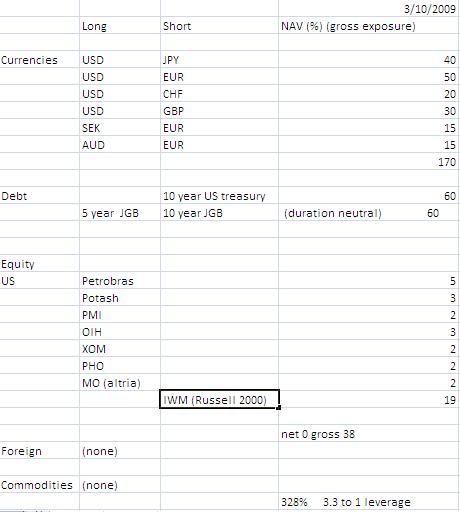
See this for positions as of 3/10/09:


I was right, however, in my bullish views of the Swedish Krona and Australian Dollar, and my bearish views of the Japanese yen but those positions weren't large enough to offset the large dollar positions. Also, the equity longs did well for the general bear market rally. There was no commodity exposure except in the form of some equity selections.

Equities:
See march 10 list for longs
short russell 2000 and S&P 500 indices
(net short 10% of nav) (will increase if it market rallies strongly)

Debt:
short 10 year Japanese government bond (not steepening trade) (60% nav)
(my reasoning is that Japanese savings rate is falling so they would not be able to finance any deficits... also economic recovery would drive up interest rates too. risks include government QE)

Commodities:
long gold (5% of nav) writing covered calls for $1000

currencies:
generally bullish on SEK/ bearish on yen (although short-yen exposure is best expressed with the short JGB position)

I am somewhat agnostic on EUR and USD now

Monday, March 23, 2009

My market view

http://seekingalpha.com/article/127105-10-reasons-why-we-still-haven-t-hit-bottom?source=article_sb_popular

I like that article as it states what is obvious to me, but I hate it when most investors agree with me. It makes it harder to understand the metagame if everyone thinks like you. Jim Rogers says that consensus investing is a disaster, and of course, empirical evidence confirms this. I am also a Popperian that attempts to falsify my own beliefs.

I think I should re-enter small short equity indices positions in the US and Europe. 15-20 percent net short exposure using indices (S&P 500 and Russell 2000 mix with a bias for s&P 500) in the hypothetical portfolio. S&P 500 is at 823 today, and it might go up to 9000. 8400-8500 might be the actual resistance though. I also should try to remove some of those equity longs except those that have commodity exposure.


Of course, I got burned on bad currency bets (betting that the dollar would strenghten) and bond bets (short 10 year US treasury) in the putative portfolio on March 18 because of the FOMC announcement of quanitative easing. I am now dollar bearish in the short term and would add to the SEK/USD position. I thought the trade deficit would fix itself, but it didn't. Furthermore, an increase in oil prices would exacerbate the trade deficit as traders bid up the price of oil. I think there will be a time (an emphasis on time) to short gold, copper, and

I do not know enough about the European equity market though. I wonder if the strengthen euro is priced in (I need to do more research on the portion of the European economy as exports to the US) or the Eastern European crisis. Too bad I cannot see the IR/NMR peaks on European equities and see the absense of "strengthening Euro" or whatever in their pricing in an attempt to arbitrage the difference between market perception and reality. You never invest on consensus, and I think these things (except perhaps strengthening Euro) are already priced in.

Since the state provides for the people in Europe, I expect lower discount rates among Europeans. I also assume that massive amounts of retirement money hasn't been shoved into European equities so my discounting hypothesis above would not apply in this economy.

The risk/reward for European shorts does not seem compelling, and I have other things to do now besides study the market.

I havent looked at enough on Europe though.

Wednesday, March 18, 2009

EVERYTHING just went to hell

I do not like USD/EUR since it past resistance and trade data doesn't seem to be helping it.

I like

SEK/EUR (25%)
SEK/JPY (30%)
SEK/ USD (15%)
CAD/EUR (20%)
AUD/EUR (15%)


Close short USD 10 year bond position at a large loss (a 47 bp move against position today)... I knew of the risks of betting against a bond market with government as a buyer (I didn't target 30 year because it has possible to have yield curve flattening and the duration risk of that position). Whatever.... I knew yields would rise without QE.

Like long GLD now... this event seems to be the catalyst to encourage more gold "investment" buying.

Tuesday, March 17, 2009

Exit strategies

I do not like USD/GBP anymore... bearish sentiment is already priced in at $1.40 so it does not seem the risk/reward is yet compelling. Most traders now know of the BoE policy of quantitative easing. If it rally which could happen during the global bear market rally, then I'll reconsider a short position.

EUR/USD approached 1.30... I think this is resistance, but we might see a breakout due to the current global "bear market rally." I do not think we are at the bottom yet. This bear market rally would become something shortable (perhaps in equities and commodities) in about a month or so.

I think the yen will get weaker relative to the dollar in this bear market rally... plan to close short yen/long dollar at 104-108 yen per dollar.

I'll close the short treasury trade at around 3.10-3.20% (I do not think yields will rise further in a deflationary environment) and they can fall that much during a deflationary bear market rally.

Thinking about the timing for a short copper/oil play... I am also bearish on gold too although people such as John Paulson seem to be betting on inflation (or numerous fiat currency collapses).

I am still a deflationist... I will not switch to the hyperinflationist or inflationist paradigm unless I see nominial wage increases or if the price of consumer goods such as clothes or cars go up. It is actually funny... many people are afraid of inflation because they experienced rising food and energy prices. I like the Austrian economics definition of deflation: the net expansion of money and credit, not the PPI, CPI, etc. I do not like the normative views of most Austrian economists, but those guided by an Austrian view who forecasted deflation [and that doesn't include Peter Schiff] got it right on the money. According to this view, one could have rising prices during a deflation in food, energy, or in imports (if a currency collapsed) as these prices would be affected by other things not directly related to credit and money supply such as scarcity (can happen during a deflation due to the lack of investment in farms, oil exploration, etc.) and demand in other countries. But again, what is funny about this deflationary bust and inflation... most people still fear inflation because they experienced the dark side of inflation (it can be caused by the symptoms of inflation, but it is not necessarily inflationary) in the form of rising food prices and energy prices (of course in the long run these are legitimate fears), but they do not appreciate one of the ostensibly "good" effects of inflation: nominal wage increases because that has been driven down by globalization.

Again, I do not care what the CPI or PPI (rising numbers do not falsify the Austrian deflation definition) says: we are still in deflation where people will become more thifty so the velocity of money will slow down and people will be relunctant to take on debt. The deflationary bust will last longer than people think and we will soon appreciate its negative effects.

Thursday, March 12, 2009

Bear market rally?

I most definitely do not think we are close to THE final bottom, but I would remove the Russell 2000 index hedges now although it was after the recent rally, so it wasn't perfectly timed.


18% exposure in long equity is not much although I think the equity picks would underperform the indices (if I would be evaluated on a relative basis) as bank stocks might lead the rally. The risk/reward is not compelling though as I could imagine a few scenarios that could bring the equities markets lower, but I do not think we will have a retest of the new lows for awhile. SPY would probably test the 800 level in a month. I really hate establishing positions after inflection points... but I think we are about to enter a bear market rally. I do not know if we are going to best the 900 level on the S&P, but 840 seems likely.


Still bearish on the entire US bond market. Short trade does have a negative carry of about 2.90%... let's say that 2.90% is when I got bearish on 10 year treasuries. So I need about 3.20% yields to break even. I think it is just a matter of time for yields to go up as I think the money to buy these the bonds would eventually dry up. There, of course, is a risk of quantitative easing by the Fed though.


Still bearish on CHF/EUR/JPY/GBP


The CHF position did well today with a fall of 3%.


PMI ---> PM.. people will still smoke...

Tuesday, March 10, 2009

positions


I don't feel that deflation (defined as falling prices) is very likely in the Eurozone given that their economy has more wage/price rigidities.

Thursday, March 5, 2009

3/05/09

I am using this blog as a way to incoherently record my predictions on the market. Too bad I am not wealthy enough to actually put money in these positions. (I am not really going to quantify exposure to some hypothetical portfolio) I just wanted a way I could pretend to be George Soros or a global macro hedge fund manager.


Currency:
getting out of CAD/EUR and would reduce the NOK/EUR exposure. SEK still seems oversold, although it current has bad technicals. Lost on SEK/EUR although I love SEK, or maybe I only love their welfare state.


like AUD/CAD in addition to AUD/EUR

USD/GBP seems good medium term, although at $1.40 does not seem to be a good entry point. I do not think it is going up to $1.50. It might go to dollar parity so it seems to have a good risk/reward.

USD/JPY seems to have a symmetry risk reward profile now, but I would keep the position.

Still bearish in EUR.

I like the positive carry from the interest rate differentials and AUD fundamentals.

Equity:
(I would use equity indices to hedge the long positions, but in my previous blog, I wanted to make it clear that I didn't feel any need have speculative short positions on indices although there was a large sell-off recently. I was not calling bottom as I did believe that US and European equities had further to fall; it was a defensive short term position to protect against a possible rally.) Equties are expected to become sort of like junk bonds; investors expect an increasing risk premium which would be reflected by higher dividend yields (to compensate from the preceived negative sortino ratio [fear of negative volatility] from equities over the last two years). Furthermore, the market should price in less growth or no growth in a deflationary environment. An increased discount parameter for many investors would be expected because of demographic changes (older people cannot "invest in the long run" so short term gains and losses would be stressed) and also the empirical fact that equities indices are lower now than in 1997. This falsifies the conception that one should invest in an equity index for the long run

I do not think the risk/reward for the reverse arbitrage on Wyeth is no longer compelling. (I was bearish on Pfizer as opposed to more "research" based pharmas such as Merck).

Merck, Petrobras, and now I like OIH since it hit a support at $67 would be hedged with short US equity indices.


Commodities:

Getting out of gold today. Techs and especially fundamentals do not justfying any reason for holding it. I knew it was a bubble when I read that increased investor demand was increasing its price. No one will lever up to buy gold now, and again people have increased discount rates. Paying bills and debt with fiat currency is much more important that protecting "wealth" for the retail investor. Of course some wealthy people will buy it to protect their "wealth."

Fear might drive up gold in the short term, and during that rally, the risk/reward for entering a short position would be better after a rally.

The NAV of USO is low now at $400 million... doesn't seem to be many retail investors pushing up oil prices. I guess it is not a good position to short it anymore.


Debt:
A slight loss for shorting US 10 year bonds. Like fundamentals on aussie economy is doing well relative to others. Maybe short 2 year bonds (at 2.51% yield)... I think further interest rate cuts are priced in, and I do not have any reason to expect them to be cut further.

Friday, February 27, 2009

Current positions

Currencies:

USD/EUR
USD/CHF
SEK/EUR
NOK/EUR
AUD/EUR
CAD/EUR

Debt:
Japanese 5-10 steepener
Short: 10 year US Treasury
Long: 10 year German Bund

Equity:
Long:
Merck
Petrobras
Short:
Wyeth (think the merger will break)
(Thinking about shorting GDX)
Longing oil equity does not have an attractive risk/return... I'll wait for OIH to support at $70.
I'll short US, European, a Japanese equities if there is a large rally. Risk/reward on short side no longer compelling.

Commodities:
Short:
USO (I think the negative roll yield because of the steep contango will force some retail investors out of their positions)
Long:
Gold (thinking about switching to a short position, as I am expecting it to rally, I am long gold despite being bearish on the longer term. I am sticking to my deflation guns, and eventually in the low velocity environment, gold will be seen as a deadweight)